Garda collector sewer, the Minister for the Environment armours the work: ‘There are 100 million to modernise it’.
04 February 2025
‘We closed the programming of the Funds for Development and Cohesion (FSC) on 31 January, and on the Lake Garda collector system we have put 100 million euro of coverage, so the work can be closed’. He guaranteed the Government's commitment to the realisation of this strategic work for Lake Garda, the Minister for the Environment and Energy Security, Hon. Gilberto Pichetto Fratin. He spoke on Monday, 3 February in Bardolino (VR), together with the undersecretary at the Ministry of Infrastructure and Transport, Hon. Tullio Ferrante, at a conference on the collector.
It was the most eagerly awaited news, that of finding the necessary funds to adapt the hydraulic sewer structure, which since the Seventies has been collecting sewage from the riparian municipalities and taking it to the centralised purification plant in Peschiera del Garda, one of the largest in Italy. The infrastructure has now reached the end of its technical life and presents various hydraulic, environmental and structural criticalities that make it necessary to upgrade it, with new pipelines from Malcesine to Peschiera del Garda.
Despite the importance and urgency of this work, the Garda collector sewer project has not yet received the necessary funding for its completion: every day that passes without the start-up of this intervention is one more risk for our most precious resource,' said Bardolino Mayor Daniele Bertasi, on behalf of twenty or so first citizens, members of Azienda Gardesana Servizi, who signed a letter emphasising the urgency of adapting the collector sewer. The letter was delivered to Minister Pichetto Fratin and Undersecretary Ferrante.
‘The realization of the collector is a priority for our community, for the entire Garda region, and for the country: the health of our lake is our health, and its protection is our common responsibility,’ Bertasi continued. ’Lake Garda constitutes the largest reservoir of drinking water in Italy, a vital resource that deserves our utmost attention and care.
Cresco: ‘The current collector at the end of its life: it is undersized for tourism growth’
Angelo Cresco, president of Azienda Gardesana Servizi, went into detail about the project to modernise the Garda collector. ‘The current collector, which over the last forty years has protected the lake from sewage discharges, has reached the end of its life,’ he emphasised. ’In the event of a break in the sublacustrine pipelines, which are a hundred metres deep and undergo bio-corrosion, we would be faced with a serious ecological and economic risk; this is why we have defined a project that envisages removing every pipe and every danger from our lake. We must not forget that Lake Garda is a resource of drinking water, as the mayor mentioned: the largest in Italy and among the largest in Europe, and already 10 municipalities on the shores drink this purified water'.
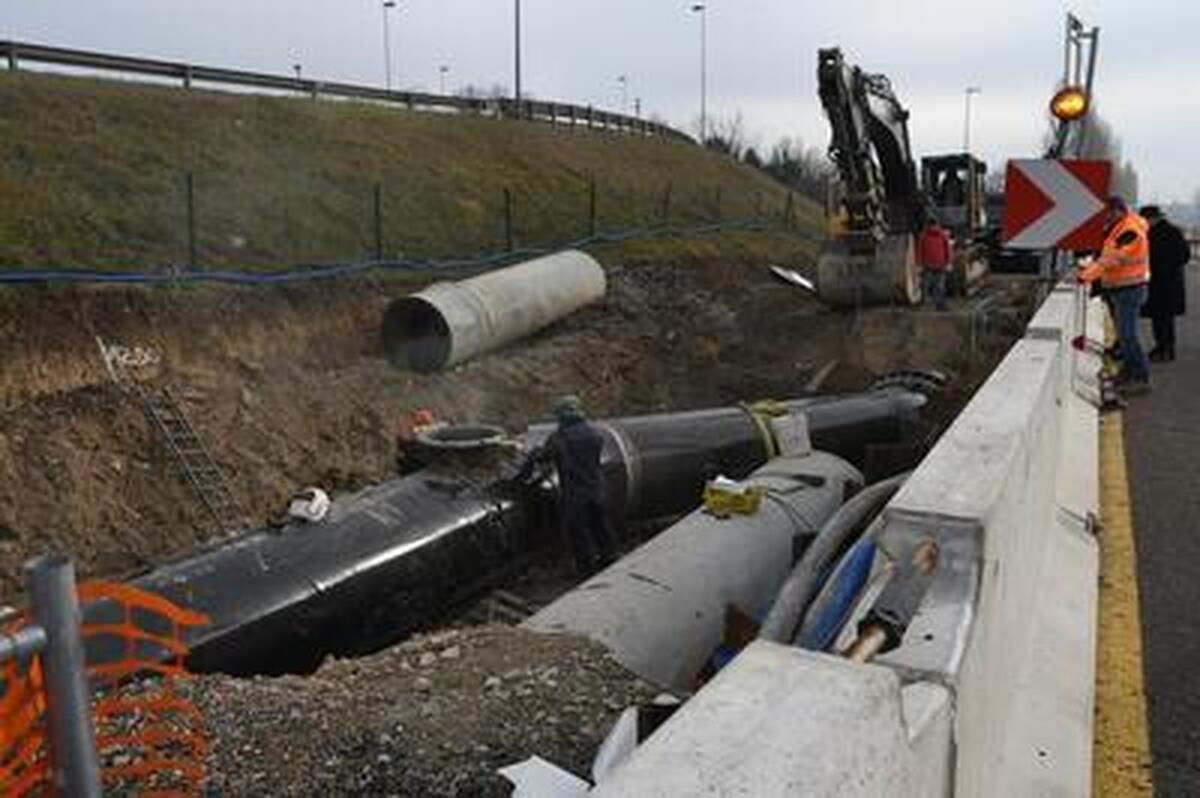
Even the current ground system of the collector is undersized for the tourist growth that the Garda Riviera has had in recent decades, Cresco added. He then listed the works that Ags has underway: ‘In Malcesine and between Castelnuovo and Lazise, the construction sites are in the testing phase, while in Torri del Benaco with the municipality we have agreed to lay the pipes together with the cycle path works so as not to have to break the bottom of the cycle path tomorrow. Unlike the Brescian side, we have already invested the entire sum at our disposal: 45 million 300 thousand euro, compared to a 2020 project that envisaged an expenditure of over 116 million euro, an amount to be updated in relation to the new price lists. We therefore need 94 million euro to be able to complete the work'.
The beauty of Lake Garda over the years has created a tourist and economic development that makes this area one of the most visited in Europe. ‘There are around 28 million visitors, the annual tourist presences, mostly foreigners, in the ‘Garda Region’, which includes 50 municipalities: it is understandable what super work the collector, built on the presences of 40 years ago, is called upon to cope with,’ said Paolo Artelio, vice-president of Confcommercio Verona.
During the conference, moderated by municipal councillor Ruggero Pozzani, speakers included Flavio Tosi, MEP, Veronese MP Paola Boscaini, and former Bardolino resident MP Aldo Brancher. Paola Boscaini, and former Bardolino resident MP Aldo Brancher, who stressed the strategic nature of the work and the need to intervene as soon as possible.
Also present in the room were Verona Prefect Demetrio Martino, provincial representatives of the police force, Veronese senators Patrizia Bisinella and Aurora Floridia, Padua senator Roberta Toffanin, numerous mayors and local administrators, representatives of economic categories in the tourism sector, and forty pupils from Bardolino's ‘Falcone Borsellino’ Comprehensive School.
All of the speakers agreed that action must be taken as soon as possible, because a possible rupture of the current pipelines, which are now obsolete, would be devastating for both the environment and the area's economy, which is based on tourism.
Read the full article on: https://www.larena.it/territorio-veronese/garda-baldo/collettore-garda-opera-blindata-100-milioni-fondi-ministero-1.12577126
Previous