Goletta dei Laghi, 4 “heavily polluted” points on Garda
27 June 2025
The photograph that Legambiente's historic Goletta dei Laghi campaign takes in 2025 on the 5 Lombard lakes (Sebino, the Lombard shores of Benaco, Lario, Ceresio and Verbano) is anything but reassuring.
Of the 32 points monitored, 15 were found to be heavily polluted, 2 polluted and 15 within the legal limits. An overall balance that marks a slight improvement compared to 2024, the year in which, probably due to the abundant rainfall, many of the samples were found to be well outside the legal limits; but at the same time decidedly worse than 2023, when, presumably thanks to the drought, data in line with what was prescribed by the legislation were found in most of the monitored points of the Lombard lakes.
On Lake Garda 4 “heavily polluted” points
Going into the specifics of the monitoring of the Legambiente campaign – which is not intended as an alternative to official controls but rather as a complement to them, reporting critical issues still present in the purification systems – On the Lombardy shore of Lake Garda the critical issues of last year are confirmed: of 6 points monitored in the province of Brescia, 4 were found to be heavily polluted:
• the mouth of the canal near the beach in the Le Rive area of Salò,
• the mouth of the stream near the port in Padenghe sul Garda,
• the mouth of the Lefà stream in the Roina area of Toscolano Maderno
• and the mouth of the stream in the Oasis of San Francesco del Garda in Desenzano del Garda)
While 2 (the mouth of the stream in the Santa Maria di Lugana area of Sirmione and that of the Toscolano stream in Toscolano Maderno) were found to be within the legal limits.
The other lakes: Sebino
On Sebino, out of 5 monitored points, 4 are heavily polluted: the mouth of the Calchere torrent in Sulzano (BS), the municipal spillway in Darsena in Pisogne (BS), the mouth of the Oglio river in Pizzo (BG) and the canal near the “Bar delle Rose” beach in Costavolpino (BG). While only 1, the mouth of the Borlezza torrent in Castro (BG), was found to be within the legal limits. The results are similar to those of last year in which all the points were found to be heavily polluted, with only the last point improving, which passed the legal limits.
Lake Como
On Lario the situation seems to have improved compared to last year. In fact, out of 11 monitored points, 6 are within the legal limits: the drain in via Torrazza in Torno (CO), sampled this year for the first time; the mouth of the Breggia torrent (CO), within the legal limits since 2019; the mouth of the Albano torrent (CO), from 2022 to 2024 outside the legal limits; the mouth of the Valle dei Mulini torrent (LC), within the limits also in 2023 and 2024; the mouth of the Esino torrent (LC) which has shown mixed results since 2011; the mouth of the Gallavesa torrent (LC), last year heavily polluted.
But still 5 points were found to be heavily polluted: the mouth of the Cosia torrent (CO), outside the limits since 2020; the mouth of the Inganna torrent (LC), heavily polluted also in 2024 and polluted in 2022 while in 2023 it was within the limits; the mouth of the Meria torrent (LC), heavily polluted in the last 3 years; the mouth of the Caldone torrent (LC), since 2009 has shown mixed results with a prevalence of concentrations outside the legal limits; and the mouth of the Varrone river (LC), within the limits from 2023.
Lake Ceresio
Even on Lake Ceresio the results obtained seem to confirm the positive trend of recent years: of 4 monitored points, 3 were within the legal limits: the mouth of the Telo di Osteno river (CO), also within the limits last year; the mouth of the Vallone torrent (VA), which was heavily polluted last year; the mouth of the Rezzo river (CO), within the legal limits from 2023. The results of the mouth of the Bolletta river (VA) were negative, within the limits in the last two years, but it is once again showing concentrations outside the limits, as from 2010 to 2022.
Lake Verbano
With fewer points outside the limits but with the confirmation of some points as critical compared to last year also the Lombardy shore of Verbano: of 6 points monitored in the province of Varese 3 points were found to be within the legal limits: the discharge of the terrace of Piazza Garibaldi in Luino, within the limits like last year; the mouth of the Bardello torrent, always found to be outside the limits since 2017; the discharge channel near the Lisanza beach, sampled for the first time last year and found to be heavily polluted. While 2 points are found to be polluted: the mouth of the Tresa torrent, in the last two years found to be within the limits and the mouth of the Acqua Negra torrent, always outside the limits since 2010 (except in 2021). One point, the mouth of the Rio Boesio, was found to be heavily polluted, confirming itself as a particularly critical point, heavily polluted since 2010.
Persistent criticalities and high concentrations of microbiological pollutants
"Among the basins historically monitored in this twentieth anniversary of the campaign - says Emilio Bianco, spokesperson for Goletta dei laghi 2025 - since the beginning, the 5 large Lombard lakes have always had a central role: Iseo, Garda, Maggiore, Ceresio and Lario. In all these years, thanks to the constant commitment of volunteers, we have followed the evolution of the quality of their waters, finding persistent criticalities and high concentrations of microbiological pollutants in some points, which indicate structural problems rather than isolated episodes. A particularly worrying fact, beyond the individual performances, including improvements, recorded since last year, concerns the clear worsening compared to 2023, when many of the samples were within the legal limits, probably due to the drought that had significantly reduced the contribution of pollutants from the tributaries».
«The twenty years of Goletta dei Laghi speak clearly – comments Barbara Meggetto, president of Legambiente Lombardia. – Shared and structured policies are needed to preserve people's health and the quality of ecosystems. We must not forget what we receive from these bodies of water, famous throughout the world: economy, well-being, mitigation of the effects of the climate crisis. Local administrations must take into account all aspects of territorial management, finding points of contact between their respective policies to achieve objectives useful to local communities. The most necessary investments are those in purification and in the integrated water cycle».
The Goletta press conference
The data on the Lombard lakes were presented this morning, Friday 27, in a press conference in Milan, at the Centrale dell’Acqua, in the presence of Pietro Raitano (MM Communications Manager), Emilio Bianco (Goletta dei Laghi Spokesperson), Christian Aletti (Lombardy sampling coordinator), Pietro Genoni (Arpa Lombardia), Diego Copetti (IRSA-CNR), Mauro Olivieri (Technical Director Acque Bresciane), Marco Domenico Bonaiti (President ATO Lecco), Marco Rusconi (Technical Director Lario Reti Holding), Massimo Mastromarino (President Ato del Ceresio), Marco Cavallin (CEO Soc. Alfa), Daniele Magni (Technical Secretariat AQST Lago di Varese), Barbara Meggetto (President Legambiente Lombardia). Moderated by Silvia Argentiero (Legambiente Lombardia) and Lorenzo Baio (vice-president Legambiente Lombardia).
Scientific monitoring: how it happens
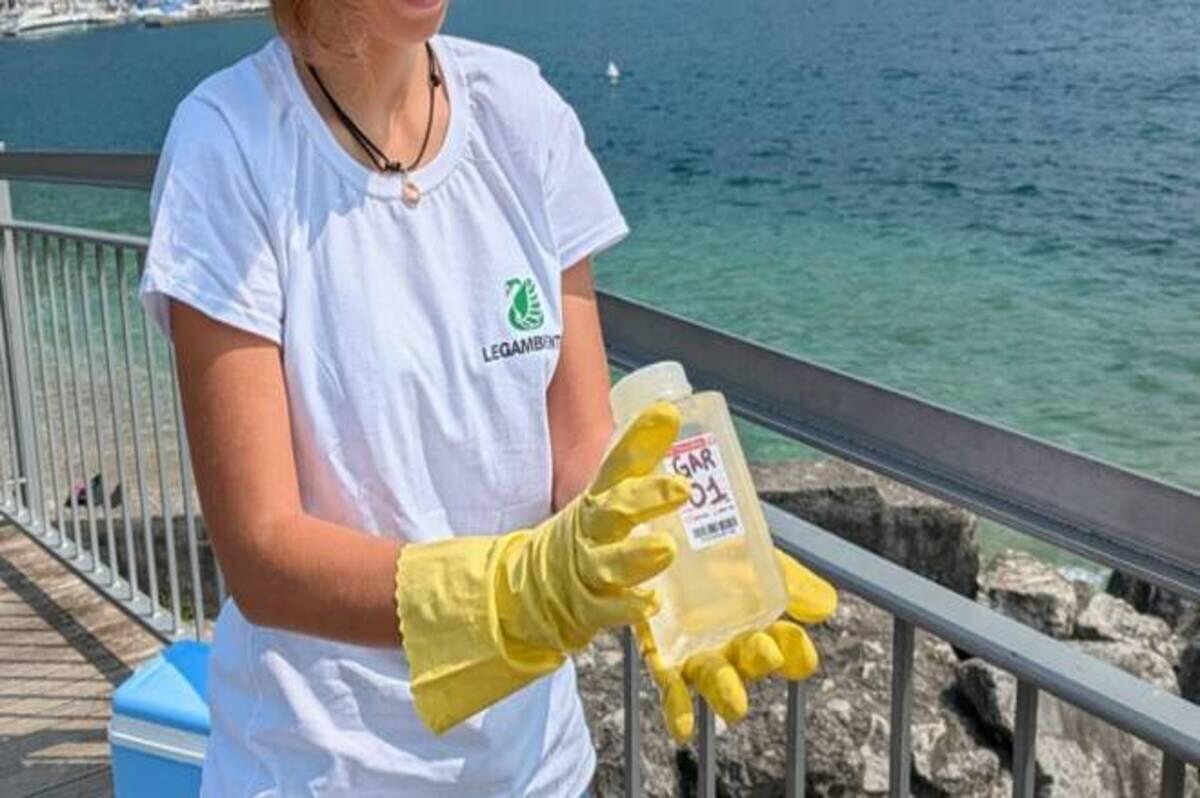
The Goletta dei Laghi samplings on the Lombard lakes were carried out from 10 to 19 June 2025 by technicians and volunteers from Legambiente. The samples for microbiological analysis were collected in sterile jars and stored in the refrigerator until the analysis, which took place on the same day of sampling or in any case within 24 hours of the sampling.
The parameters investigated are microbiological – intestinal Enterococci and Escherichia coli – classifying as “polluted” the samples that exceed the legal limits and as “heavily polluted” those that exceed them by more than double, as established by the national legislation on bathing waters (Legislative Decree 116/2008 and implementing decree of 30 March 2010). The Goletta dei Laghi results do not certify the suitability of the sampling points for bathing. The sampling points are chosen based on the potential risk of pollution, based on the reports of Legambiente circles and citizens through the SOS Goletta service. River mouths, streams, drains and small canals represent the main routes of bacterial contamination in the lakes, due to insufficient purification or illegal discharges.
Read the full article https://www.gardapost.it/2025/06/27/goletta-dei-laghi-sul-garda-4-punti-fortemente-inquinati/#:~:text=Sul%20Sebino%2C%20di%205%20punti,%E2%80%9D%20a%20Costavolpino%20(BG).
Previous