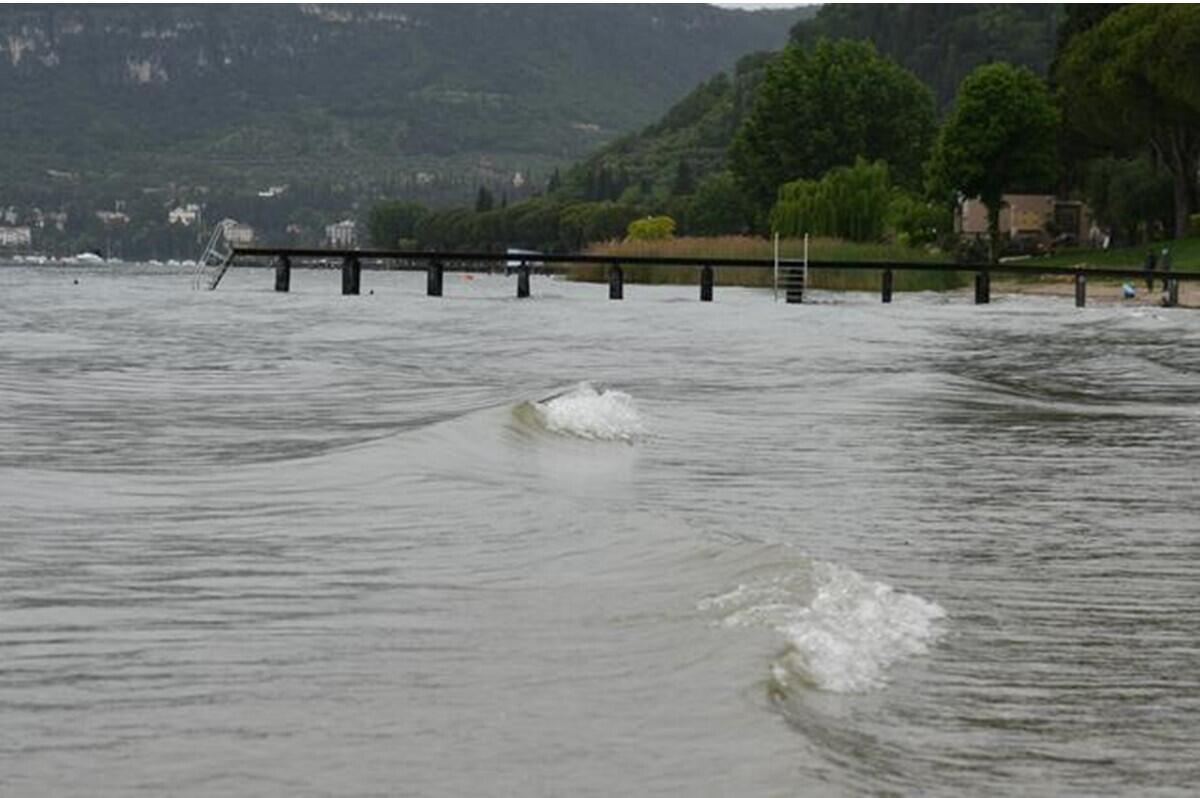
The lake rises due to rain: 10 centimetres in 8 days. "But the emergency is not over"
27 May 2023
These days the Garda is flooding one centimetre of water a day. Ceresa: 'Situation excellent, but we are not out of it and to say that we have come out of the ford would be a mistake'.
It has only been a few weeks since it was said that at least a month of uninterrupted rainfall would be needed to recover Garda's water deficit. It seemed utopian, given the continuing drought and above-average April temperatures. Instead, Jupiter Pluvius is bringing relief to the Garda basin and the Veronese and Mantuan countryside, at least for now and net of the devastating events experienced in recent days by the people of Emilia-Romagna.
In eight days, Lake Garda has gained ten centimetres: from almost 67 centimetres above the hydrometric zero in Peschiera recorded on 11 May, it rose to over 76 centimetres yesterday (source: Laghi.net). Considering that each centimetre is equivalent to 3.7 million cubic metres of water, the gain is 37 million cubic metres.
Contributing to the balance is the positive balance between what comes in from the Sarca tributary (almost 80 cubic metres per second) and what goes out into the Mincio through the Salionze dam (14 cubic metres/sec), the latter's flow rate being almost minimal.
"As a matter of fact, the irrigation season has not yet started," notes Pierlucio Ceresa, secretary general of the Garda Community, "when we met at the end of April to establish the management plan for the month of May, we had hypothesised some scenarios that fortunately did not occur because the rain helped us. Now the lake is flooding an inch a day: an excellent situation, but we must beware of easy euphoria because we have not yet left the ford and to say that the critical situation is over would be a mistake'.
To understand this, a comparison is enough, made possible by the data collected on the Garda Community website: on 19 May 2022 the lake was at 90 centimetres (14 more than now) and yet it arrived at the height of the summer season with the uncertainty of being able to guarantee the water supply to the crops of the Mantuan countryside, to which the outflows in August were much reduced compared to the concessions.
"In July and August, the outflows will be substantial," Ceresa noted, speaking however of "cautious optimism" because "the scenario we had envisaged did not occur: in the coming days, more rain is expected, both in the Garda basin and in the Mantua area, and this will ensure that the outflow at 14 cubic metres per second can be maintained.
A cautious optimism is suggested by the filling percentage of the basin, which yesterday was almost 60%: a value that despite its name does not refer to the entire water availability of the largest Italian lake, but only to the quota that can be regulated through the Salionze dam and is therefore available for irrigation purposes (between +15 and +140 centimetres on the hydrometric zero, while the depth of Garda is measured in metres: 346 the maximum, 136 the average).
Together with the large lakes, the flow rate of Italy's largest river, the Po, is growing: at the Pontelagoscuro (Ferrara) monitoring station, increases of up to 2,000 cubic metres per second have been recorded (at the end of last July, at the height of the water crisis, it was barely 100 per second), the Po River District Authority reported yesterday, noting that "currently in this section, outflows are slightly down, pending the new increase generated by the expected rainfall in the District.
Unstable weather conditions are expected for the next 7-10 days, with temperatures below the values for the period," the Authority continues. "On Thursday 25, there will be the next meeting of the Observatory on water use in the Po Basin where, following the sharing and evaluation of all the meteorological-hydrological data collected in this particularly wet May, the indices will be updated and the degree of water severity will be reassessed.
(From L'Arena, 20 May 2023. Full article here)
Previous