Beached shrimps everywhere. Storm makes an ecatomy
17 September 2024
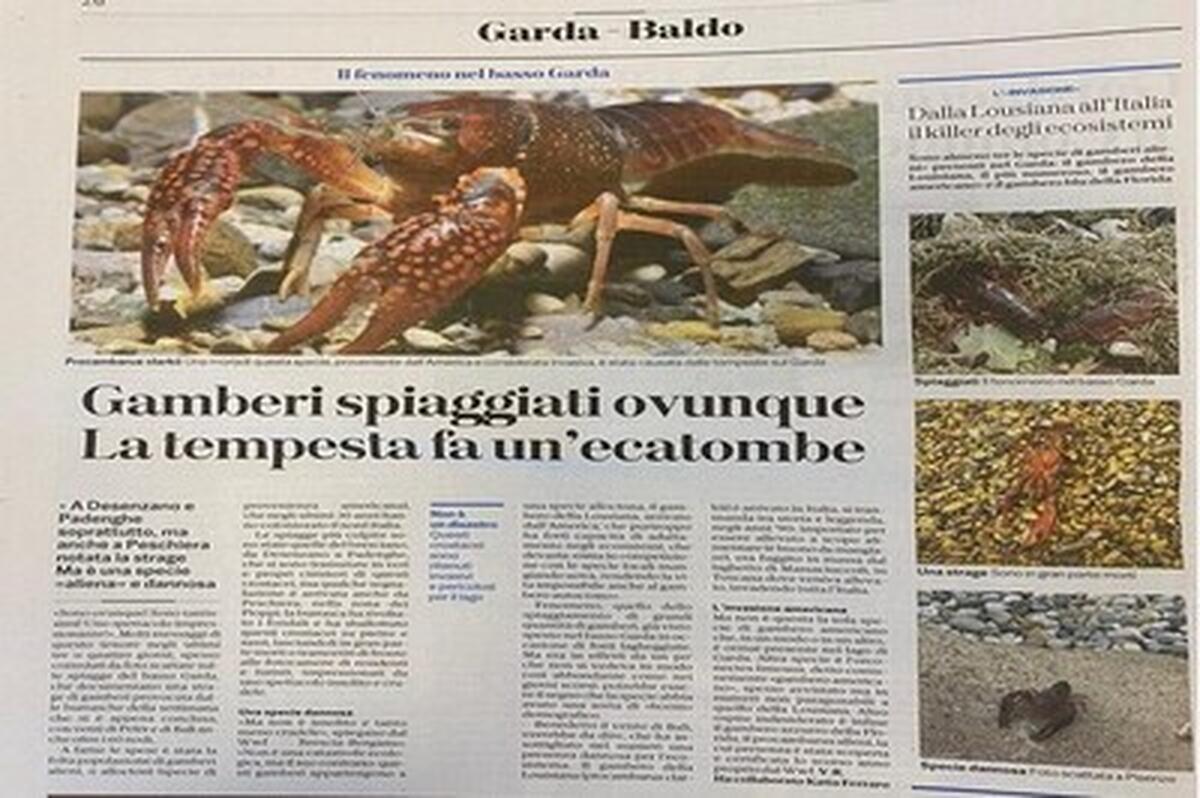
‘They are everywhere! There are so many of them! An impressive spectacle!’ Many messages of this tenor in the last three or four days, often accompanied by photos taken on the beaches of the lower Lake Garda area, documenting a shrimp massacre caused by the gales of the week that has just ended, with Pelèr and Bali winds even exceeding 60 knots. The victims were the large population of alien, or allochthonous shrimp (a species of American origin), which have colonised northern Italy over the last 30 years.
The beaches hardest hit were those in the Brescia area, from Desenzano to Padenghe, which have turned into veritable cemeteries of these crustaceans, but a few reports also arrived from Peschiera, in the area of Pioppi: the gale turned the seabed upside down and tossed these crustaceans onto stones and pebbles, leaving them mostly dead or stunned in front of the cameras of residents and tourists, impressed by an unusual and cruel spectacle.
A harmful species
‘But it is neither unusual nor cruel,’ explain the WWF Brescia-Bergamo: ’It is not an ecological catastrophe, but its opposite: these shrimp belong to an allochthonous species, the Lousiana shrimp, arrived from America, which unfortunately has strong adaptive capacities in ecosystems, which it devastates: it competes with local species by eating eggs, making life impossible even for the native shrimp.
A phenomenon, that of the beaching of large quantities of crayfish, already often seen in the lower Lake Garda area on the occasion of heavy lake flows.
But it had indeed been a while since it had been seen as abundantly as in recent days: it could be a sign that the species has had a sort of demographic ‘boom’.
Blessed is the wind from Bali, one might say, which has thinned out in numbers a presence detrimental to the eco-system. The Louisiana crayfish (procambarus clarkii) arrived in Italy, between history and legend, in the 1990s: imported to be bred for food (it is good for eating), it had fled en masse from the Massaciuccoli pond in Tuscany where it was bred, invading all of Italy.
The American invasion
But this is not the only species of American crayfish that, in one way or another, is now present in Lake Garda. Another species is the orco-nectes limosus, commonly known as the ‘American crayfish’, often sighted but in numbers not comparable to the Lousiana crayfish. Finally, another unwelcome guest is the Florida blue shrimp, Procambarus alleni, whose presence was discovered and certified last year by the WWF. V.R.
Read the article in: L'Arena Tuesday 17 September 2024
Previous