Integrated and Sustainable Mobility Plan of the Lake Garda Area
29 June 2026
Institutions and Universities Join Forces for the Integrated and Sustainable Mobility Plan of the Lake Garda Area
SALÒ – A Framework Agreement has been signed between the Comunità del Garda, the Provinces, the Mountain Community and the Universities to develop a shared mobility strategy for Italy's largest lake.
Lake Garda has launched a shared strategic initiative to address one of its greatest challenges: mobility.
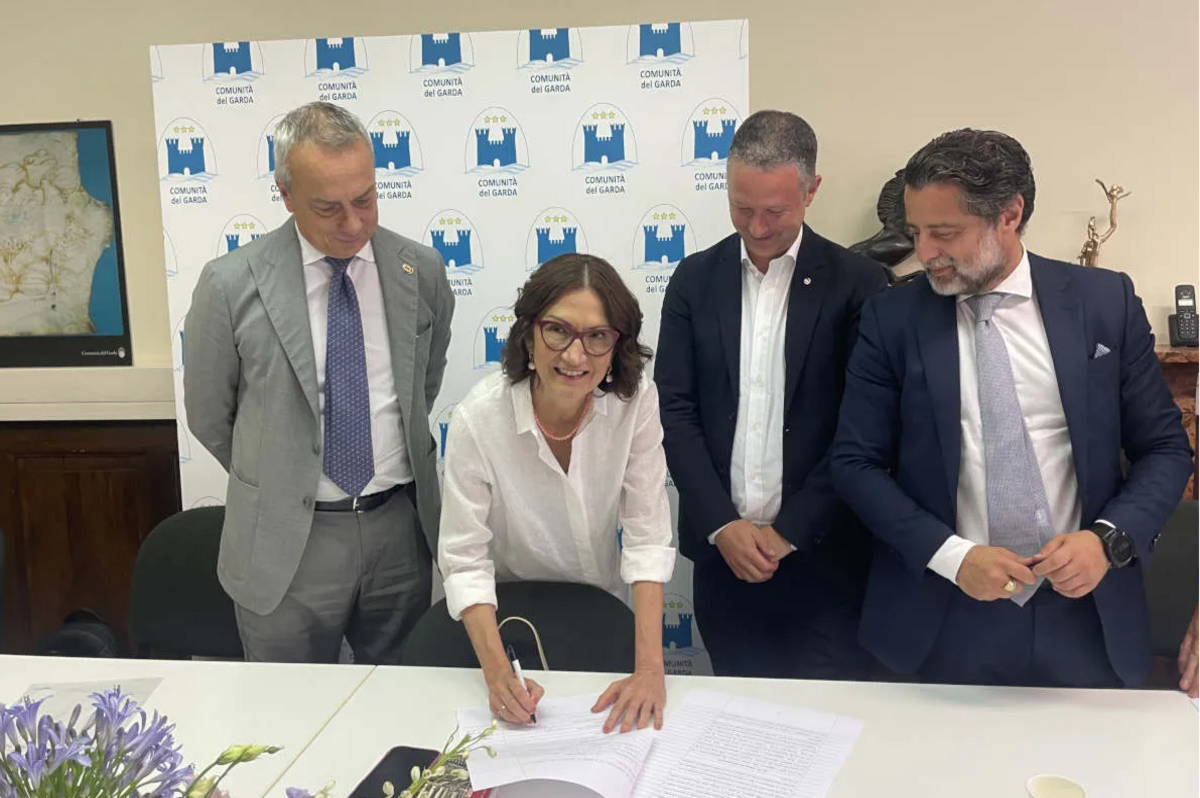
Yesterday in Salò, the Framework Agreement for the development of the Integrated and Sustainable Mobility Plan for the Lake Garda Area was signed. The initiative is promoted by the Comunità del Garda together with the Provinces of Brescia and Verona, the Autonomous Province of Trento through the Alto Garda Park Mountain Community, the University of Brescia and the University of Padua.
The Plan's Objectives
The aim is to create a unified vision for mobility across Italy's largest lake, overcoming administrative boundaries and coordinating transport policies within an area that every year sees millions of journeys made by residents, workers and tourists.
The Plan will provide the basis for data collection, mobility analysis and the identification of infrastructure priorities, with particular attention to integrating public and private transport, lake and land connections, cycling mobility, accessibility, and the reduction of congestion and emissions.
The Garda High-Speed Rail Station
Among the strategic priorities is the future Garda High-Speed Rail (HSR) station, regarded as a key opportunity to strengthen the area's national and international accessibility.
The Plan will define how the HSR station will be integrated with existing transport networks, ensuring that it becomes a genuine gateway to the entire Lake Garda region.
Gelmini: "Competitiveness, Sustainability and Quality of Life"
"For the first time, institutions and universities are working together to build a shared vision for mobility around Lake Garda," said Mariastella Gelmini, President of the Comunità del Garda. "We are not simply talking about roads and transport, but about competitiveness, sustainability and quality of life. Our goal is to make Lake Garda a model of innovation and territorial integration, also by taking full advantage of the opportunities offered by major infrastructure investments, beginning with high-speed rail."
The Framework Agreement marks the beginning of a process aimed at making Lake Garda more accessible, better connected and more sustainable, while providing participating institutions with concrete tools to guide future infrastructure decisions and support the area's development over the coming decades.
Statements
Emanuele Moraschini, President of the Province of Brescia
"Mobility around Lake Garda is a highly complex issue that cannot be addressed through isolated interventions. It is a system where different forms of mobility coexist alongside environmental and infrastructure constraints, geological vulnerabilities and traffic volumes that are growing faster than traditional solutions.
In recent years, the Province has carried out continuous work on bridges, roads, roundabouts, unstable slopes and critical junctions. Projects range from the long-awaited Rovizza interchange in the southern Garda area to safety works on the Forra Road, improvements to the road network in Lonato, and studies for a specially equipped ferry offering an alternative lake crossing for cyclists between Salò and Limone.
These represent only part of the strategic interventions—some completed, others nearing completion—implemented within an integrated vision for Garda mobility. The new agreement with the Comunità del Garda, the Provinces of Verona and Trento, and the Universities of Brescia and Padua provides an even stronger framework for coordination and planning.
The Agreement establishes a shared institutional knowledge base focused first and foremost on identifying what can realistically be achieved. The contribution of the universities ensures the scientific rigour needed for infrastructure planning and informed decision-making.
For the Province of Brescia, this means fully exercising its coordinating role through close institutional cooperation supported by effective planning tools, enabling projects that reflect a long-term vision for the territory and anticipate the future mobility needs of the entire Lake Garda area."
Paolo Fontana, Provincial Councillor for Public Works, Roads, Mobility and Intermodal Transport
"Having a transport network that meets the needs of the territory is an added value for quality of life, commercial connections and tourism.
The Framework Agreement signed by the Province of Brescia enables an even more comprehensive approach to improving the provincial road network, particularly in the Lake Garda area, to which the Provincial Administration has always devoted special attention.
This additional planning instrument also strengthens the Province's ability to act beyond the limits of its direct responsibilities, which are often constrained by the legislative framework introduced by the Delrio Reform."
Flavio Massimo Pasini, President of the Province of Verona
"This agreement reflects a simple reality: administrative boundaries rarely coincide with the everyday lives of citizens. School, work, healthcare and leisure all require travel that extends beyond municipal and often provincial borders.
Lake Garda clearly demonstrates that natural, economic and social dynamics transcend administrative divisions. An inter-territorial approach is therefore not an abstract choice but a necessity. It means looking beyond political maps and focusing instead on the real mobility needs of those who live, work and travel in this area."
Mattia Gottardi, Councillor for Transport and Mobility, Autonomous Province of Trento
"The reason for joining this agreement together with the other Provinces is clear: the Lake Garda area is a territory of extraordinary beauty and outstanding cultural and social value, whose national and international tourist appeal continues to grow.
However, these positive aspects must not distract those responsible for planning the area's future from recognising that this unique landscape could be seriously threatened if the significant—and often uncoordinated—increase in road traffic is underestimated.
Mobility conditions directly affect residents' quality of life, the efficiency of public services and, ultimately, the attractiveness of the area itself.
For this reason, we now need a broader vision capable of promoting coordinated intermodal transport integrating road, rail and water transport. Such challenges cannot be solved through fragmented local approaches.
The Autonomous Province of Trento therefore strongly supports this initiative, which will produce scientific studies examining different mobility scenarios and integrated transport models. These findings will provide participating administrations with a solid basis for medium- and long-term decisions.
The availability of comprehensive and reliable data will also lay the foundations for future cooperation with neighbouring provinces, fully consistent with our responsibility to protect and preserve Italy's largest lake."
Read the article: https://www.gardapost.it/2026/06/23/istituzioni-e-universita-insieme-per-il-piano-di-mobilita-integrata-e-sostenibile-dellarea-gardesana/
Previous