The fisherwoman gives up: ‘It's not my lake anymore’
23 September 2025
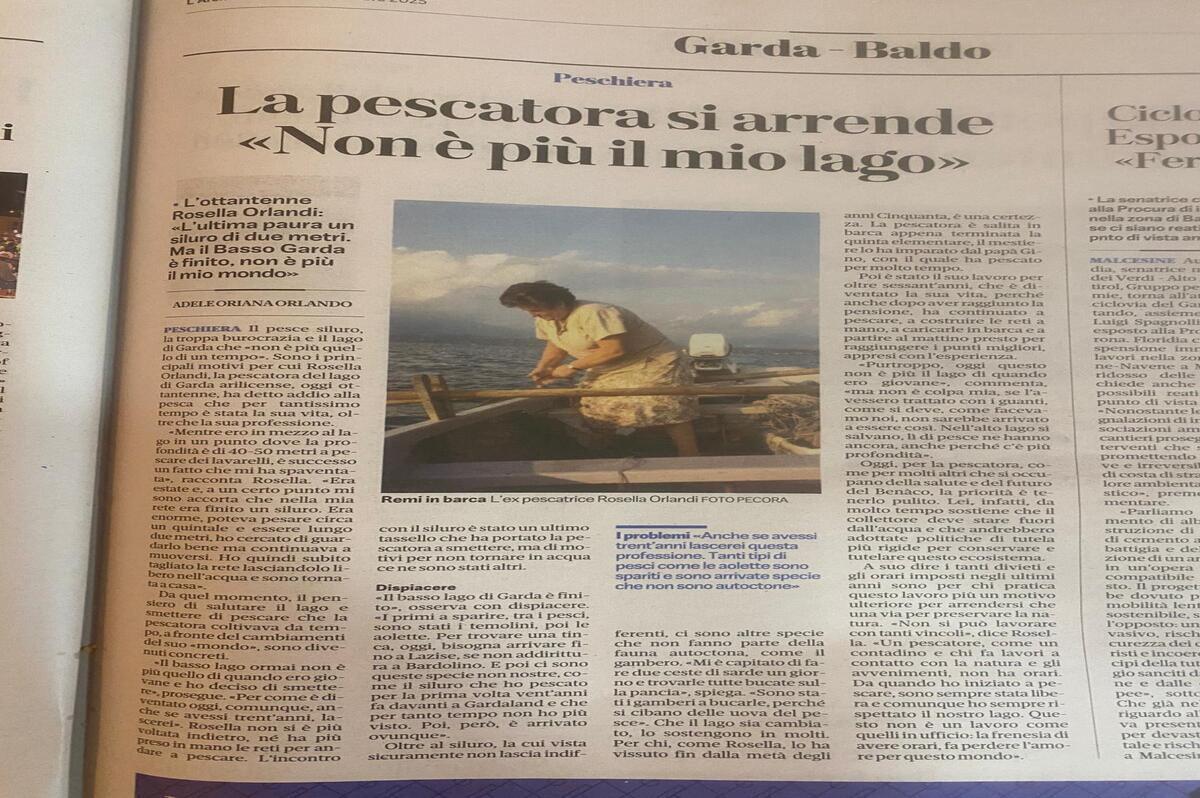
Peschiera. Catfish, excessive bureaucracy and Lake Garda, which ‘is no longer what it used to be’. These are the main reasons why Rosella Orlandi, the 80-year-old fisherwoman from Lake Garda in Arilico, has said goodbye to fishing, which for a long time was her life as well as her profession.
'While I was in the middle of the lake at a depth of 40-50 metres fishing for whitefish, something happened that frightened me,' says Rosella. 'It was summer, and at one point I realised that a catfish had got caught in my net. It was huge, weighing about a hundredweight and two metres long. I tried to get a good look at it, but it kept moving. So I immediately cut the net, leaving it free in the water, and went home."
From that moment on, the thought of saying goodbye to the lake and giving up fishing, which the fisherwoman had been doing for a long time, in the face of changes in her ‘world’, became a reality.
‘The lower lake is no longer what it was when I was young, so I decided to stop,’ she continues. ‘The way it is today, even if I were thirty years old, I would still quit.’ Rosella never looked back, nor did she ever pick up her nets to go fishing again. The encounter with the catfish was the final straw that led the fisherwoman to quit, but there were other reasons for not returning to the water.
Disappointment
“The lower part of Lake Garda is finished,” he observes with disappointment. "The first fish to disappear were the temolini, then the aolette. To find a tench today, you have to go as far as Lazise, if not Bardolino. And then there are these non-native species, such as the catfish I caught for the first time twenty years ago in front of Gardaland and which I haven't seen for a long time. But then it arrived everywhere.
In addition to catfish, which certainly make an impression when you see them, there are other species that are not part of the native fauna, such as crayfish. “I happened to catch two baskets of sardines one day and found them all with holes in their bellies,” she explains. 'It was the crayfish that pierced them because they feed on fish eggs'. Many people agree that the lake has changed. For those who, like Rosella, have experienced it since the mid-1950s, it is a certainty. The fisherwoman got on a boat as soon as she finished fifth grade and learned the trade from her father Gino, with whom she fished for a long time.
It then became her job for over sixty years, which became her life, because even after reaching retirement age, she continued to fish, to make nets by hand, to load them onto the boat and to set off early in the morning to reach the best spots, learned through experience.
‘Unfortunately, today this is no longer the lake I remember from my youth,’ she comments, ‘but it's not my fault. If they had treated it with care, as we did, it wouldn't have ended up like this. The upper lake is still okay; they still have fish there, partly because it's deeper.’
Today, for the fisherwoman, as for many others who care about the health and future of Lake Garda, the priority is to keep it clean. In fact, she has long argued that the collector should be kept out of the water and that stricter protection policies should be adopted to conserve and protect this ecosystem.
In her opinion, the many bans and restrictions imposed in recent years are more of a reason for those who do this work to give up than a way to preserve nature. ‘You can't work with so many constraints,’ says Rosella. ‘A fisherman, like a farmer and anyone who works in contact with nature and the elements, has no set hours. Since I started fishing, I have always been free and have always respected our lake. This is not a job like those in an office: the frenzy of having set hours makes you lose your love for this world.’
Read the full article in L'Arena on 22 September.
Previous