New projects for the road system on Lake Garda
23 May 2023
With the opening of the tourist season also comes the timely problem of traffic congestion, associated not only with the environmental impact it causes but also with the issue of safety.
Proposals over the years have been various, but they have always clashed with the difficulty of implementation due to the morphology of the coastline and thus cascade with the very high costs. The road that runs all along the lake is very narrow, in many places it also crosses towns and in others it runs alongside cliffs or hillsides. Its widening is for these reasons unfeasible.
The alternatives over the years have been for the construction of tunnels, which would, however, on the one hand, irreparably compromise the landscape and, on the other hand, waste a lot of resources.
Even for the installation of a railway line some proposals have been made in the past, which have been systematically rejected either because of their route (it would be invasive to build the tracks) or always because of the cost.
A few days ago, a conference on road safety was held in Torri del Benaco. The mayor proposed evaluating the creation of an alternative route that would not disfigure the nature of the area too much. Now that there are financial resources coming in with the PNRR, it is time to talk about it and take advantage of it. A second access road to the lakeshore would give the lakeshore villages air and improve the quality of the road system.
In February last year, the Veneto Regional Council approved a memorandum of understanding with Rfi to initiate collaboration on a shared programme for the development of a proposed rail link with Catullo Airport and the creation of sustainable, intermodal mobility on the eastern shore of Lake Garda, centred on the railway component. The intention was to improve accessibility to tourist areas by solving the infrastructural problems connected to the increase in tourist flows in the Garda area.
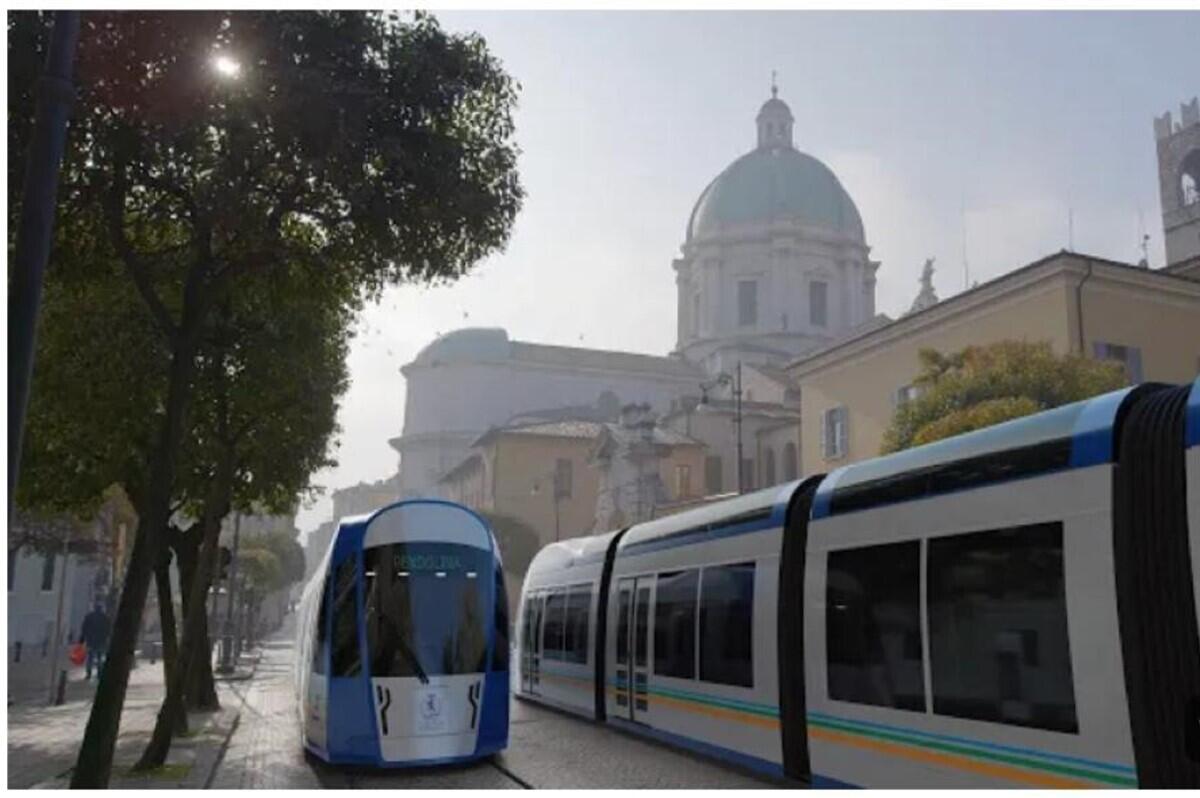
A problem that led the three provinces bordering the lake to the same conclusion: to strengthen the railway routes, with new lines. Verona is planning one that will reach Lazise and Bardolino, Trento wants to create a connection from Rovereto to Riva-Torbole and Brescia intends to reduce traffic on the 45bis, with a dedicated line to Roè Volciano and Salò. On the Brescia route, there are plans for a fast metro-tramway, modelled on the French tramways and similar in some respects to the Bergamo-Val Seriana.
In view of the already rumoured innovations planned for public transport from Brescia to Lake Garda, the news in the last few hours is that the fast metro-tramway is the transport system with the 'best performance'. At the request of the Province, the University of Brescia conducted a pre-feasibility study. Various parameters were examined and it was concluded that this is the best option because it has a good commercial speed, lower costs, and a faster construction time.
Now, in the next two months, the route will be chosen, between the two hypotheses on the field: either alongside the 45 bis, a less complex hypothesis, but capable of intercepting fewer passengers; or passing through the centre of the villages. Then, next autumn, the cost-benefit analysis will be carried out and the study will be closed, to assess the technical and economic feasibility. More than 18 kilometres, at an estimated cost of around EUR 1 million, but the connections between the villages in the Benaco area would make a huge leap in quality.
Further cost-benefit analyses will be available at the next meeting in September, and this will be the most important phase because it could finally give way to the final decision.
Previous